
OCD 101 Part 1: The "I'm so OCD" Myth

“I’m so OCD!”
Honestly, hearing this sounds like nails on a chalkboard.
This is sadly a common thing to say, and I’m certain that you have heard someone say this. You may have even said it yourself. Saying “I’m OCD” is kind of like using the brand name Post It to describe all sticky notes; eventually, Post It loses its brand recognition.
Saying “I’m so OCD about (x)” may be a “cute” way to draw attention to the odd obsessive-like behavior of maintaining a clean and tidy space, or other behavior that seems quirky or meticulous, but it delegitimizes OCD as a condition.
OCD, or Obsessive-Compulsive Disorder, is a legitimate, often debilitating condition and not some personality quirk or fascination with maintaining a pristine space. Saying that you’re “so OCD” about anything simply reduces the reality of the condition, which often goes unnoticed, even by those who have it.
The International OCD Foundation estimates that “more than ⅔” of the public can’t accurately identify OCD. While not the only reason, not being able to recognize OCD is among the reasons why the myth about it being a personality quirk exists. This is the first post in a series about OCD. The purpose of this post is to provide you with information about what OCD is, how it affects everyday life, when it may be time to seek help, and who it impacts.
What OCD Actually Is
As you’ve learned, OCD is not some personality quirk where a person is defined as a “neat freak” or “particular.” OCD can be a debilitating mental health condition that causes significant impact in a person’s life. The symptoms are self-perpetuating, unwanted, and anxiety-provoking. People with OCD often describe their experiences with obsessions and compulsions as if they’re in a bubble, absorbed into it and disconnected from everything else going on around them.
In general, OCD can be described as possessing the following elements:
- Obsessions
- Anxiety/Distress
- Compulsions
- Temporary Relief/Reset
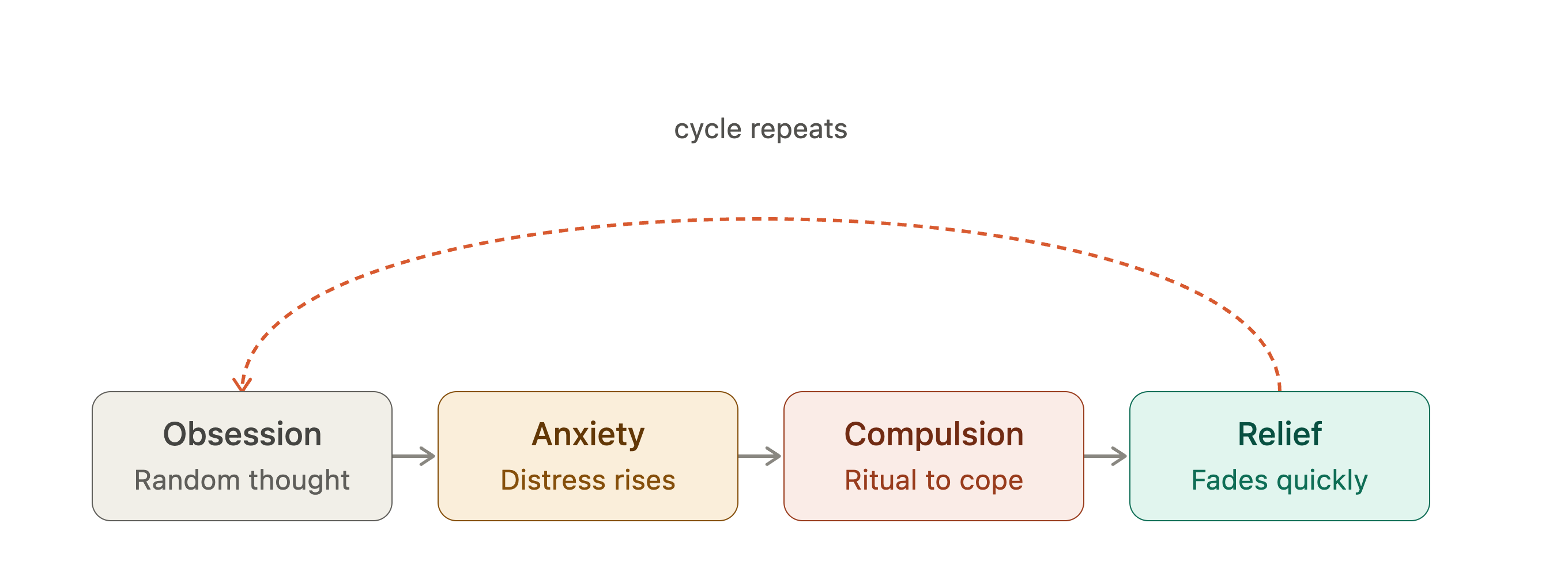
Obsessions are unwanted, intrusive thoughts, images, or urges that sometimes feel as if they “pop up” from nowhere. Obsessions are ego-dystonic (I’ll explain this in the next section), and they cause a lot of anxiety and distress. Obsessions have a variety of themes depending on the person, such as contamination, sexual thoughts, taboo themes, and religion, to name a few. A few examples of obsessions are “What if I hurt someone I love,” “What if I am gay,” or “What if I just ran over a person.”
These obsessions can occupy much of someone’s day and cause impairment in day-to-day functioning - running late for meetings, missing out on time with loved ones, and other losses. It’s understandable that these obsessions cause significant anxiety and distress as a person begins to watch their life fall apart around them.
To deal with the obsessions, a person may develop compulsions. Compulsions are a kind of behavior aimed at providing relief from the obsession. Compulsions take on a wide range of forms; some are internal and others are external. Internal compulsions are not readily visible to others because they generally happen within the person - providing oneself with affirmations, counting in one’s head, and so on. Externalized compulsions are generally visible to others. Common examples of externalized compulsions may be frequent or prolonged hygiene rituals, excessive praying, repeated checking, or frequent reassurance-seeking.
There’s much more to say about compulsions, but the idea behind them is that they’re performed in order to provide relief from the obsessional doubt, and they work, at a cost. Whenever a person engages in compulsions, there comes a point where relief is found. The person feels better, less anxious, and may even have a temporary increase in confidence. But the relief is only temporary. While compulsions offer temporary relief, they never truly neutralize the obsession as intended, and the obsession returns, often in full force. There’s another downside: the compulsive ritual may have to be intensified, done for longer or more vigorously, to get the same relief. This is how OCD keeps the person stuck: the cycle repeats, often getting harder to break each time.
OCD Is Ego-Dystonic
This may be a new vocabulary word for you, so let’s define it: Ego-dystonia, or ego-dystonic, refers to thoughts, impulses, or behaviors that feel unwanted, foreign, and in direct conflict with a person’s core values, beliefs, and self-image.
The obsessions a person experiences in OCD are ego-dystonic: the person doesn’t want them, and they’re unwelcome. On top of being unwelcome, obsessions are distressing, and because OCD is a kind of doubting condition, that distress can rapidly increase as the person begins to doubt whether they could be the kind of person the obsession is stating or implying, such as “I could be a dangerous person” or “what if I am a pedophile?”
In part due to the combination of OCD’s ego-dystonic nature along with the distress and doubt it creates, a person can be driven to engage in compulsions as a means to resolve that doubt. The day-to-day impact is significant and cannot be overlooked.
Day-to-Day Impact
OCD can seriously impact a person’s life. OCD symptoms may take up a significant amount of time, can ruin relationships, and even cause a person to think terribly about him or herself. Of course, OCD doesn’t impact each person in the same fashion. One person may be able to tolerate it better than another before seeking help, and this means that people seek help at different times. Thankfully, the diagnostic guidelines give a clear indication about when to seek help: when symptoms last more than an hour a day and cause real distress, or interfere with your valued activities.
Obsessions and compulsions can occupy a lot of your time. A person could obsess over anything for hours on end; however, even 10 to 15 minutes of obsessing could cause a person to lose track of time, a conversation, or even to misplace their attention long enough for an accident to happen. Obsessions are also unwanted, and thereby cause distress, anxiety, and other difficult to tolerate emotions which can further impact your day to day.
Compulsions vary by person, obsessional content, and other factors. A person with contamination-based OCD may engage in handwashing behaviors which last 10 minutes, while a person with sexual-orientation-based OCD could spend countless minutes checking for groinal sensations. There are various other examples, and in any case, these compulsive behaviors are not something a person wants to do but rather feels compelled to do. The compulsion is not only time consuming but causes significant distress in the person’s life. Again, missed opportunities, stressed interpersonal relationships, and poor work performance are only a few examples of impact.
Whether obsessions, compulsions, or both combined, it can be helpful to consider the total amount of time spent engaged in those behaviors. If you’re engaged in either for an hour or more a day and there’s a clear impact in your life, then I strongly encourage you to seek help from us or another trained clinician. An hour a day is our recommended threshold for when you should seek help; however, there’s one additional item for you to consider: impact on valued areas of life.
Given that obsessions and compulsions are unwanted and cost valuable time, they’re likely to impact valued areas of your life. Valued areas of life are the areas that are significant to you for whatever reason. Common examples include work, family, and other interests. Here’s an example: a person could have an obsession about whether she’s left the stove on while leaving home for her child’s birthday party at the local pool. Uncertain, she returns home to check. She spends approximately 20 minutes fiddling with the knob before leaving for the party. While at the party, she continues to worry about the stove and whether the house could burn down. These worries pull her away from being present at the party, and now she feels guilty for not “being there.”
This is one example of how OCD can impact all or some of those valued areas of life. When these kinds of experiences happen, it’s another indication that it’s time for you to seek help.
Who OCD Affects
The short answer is that OCD can impact anyone; it doesn’t discriminate. OCD can impact a person of any age, background, ethnicity, or race. According to Harvard Health, OCD affects up to 3% of people globally, and a 2025 study of adults in 10 countries found something similar: about 3% had OCD in the past year. In the US, the National Institute of Mental Health reports that, based on a national survey conducted from 2001 to 2003, an estimated 1.2% of US adults had OCD in the past year, with females more likely to have OCD than males (1.8% compared with 0.5%).
Harvard Health also notes that OCD most often starts in childhood or before the age of 25 and does not usually develop after age 30. The 2025 study agrees: half of the cases it identified began by age 17, and more than 80% began by age 24. The International OCD Foundation (IOCDF) reports that it takes more than 7 years, on average, for a person to receive an accurate OCD diagnosis, and Harvard adds that it’s common for people to live with symptoms for 5 to 10 years before seeing a psychiatrist.
These stats may sound surprising; however, it is common for people to go years without a formal diagnosis. It’s not easy to uncover what’s the matter. There’s often a lot of shame or guilt, or the obsessions and compulsions are written off as normal or even performed out of an abundance of caution. There are many ways to mask symptoms and countless reasons why late or prolonged diagnoses are common. The 2025 study also found that only about 1 in 5 adults with OCD had received any mental health treatment in the past year.
Where to Go from Here
If you’ve read this far and recognized yourself in any of it, I want you to know two things. You’re not alone, and what you’re experiencing is not a personality flaw or a quirk you should be able to shrug off. OCD is a real condition with a real name, and it is treatable. You may have gone months or years without anyone explaining what was happening, and finally having words for it can be a relief in itself.
A natural question at this point is how OCD differs from the habits and routines we all have. That’s exactly where we’re headed. In the next post, we’ll look at how compulsions differ from everyday habits and some questions you can ask yourself to tell the difference.
If you’re ready to talk with someone about what you’re experiencing, I’d love to help. Schedule a consultation with us and let’s talk about what support could look like for you.