
OCD 101 Part 4: I-CBT and Medication: Other Ways to Treat OCD

In the previous post, we looked at what Exposure and Response Prevention (ERP) looks like in practice. In this post, we’ll look at another approach, Inference-Based Cognitive Behavior Therapy (I-CBT), and then briefly cover the role of medication.
Inference-Based Cognitive Behavior Therapy
Inference-based cognitive behavior therapy (I-CBT) is not to be confused with cognitive behavior therapy for insomnia (CBT-I). The letters are the same and the position of the ‘I’ makes a difference.
I-CBT is a “newer” treatment for OCD. It is interested in what happens further up the obsessional sequence, while ERP is focused further down the sequence. I-CBT is interested in how we come to develop the (obsessional) doubt at all and how to prevent it from happening in the first place. ERP has the longer research history, backed by decades of research, while the research on I-CBT is newer and still growing.
The Obsessional Sequence & Inferential Confusion
Here’s an example of the obsessional sequence and where each kind of OCD treatment focuses:
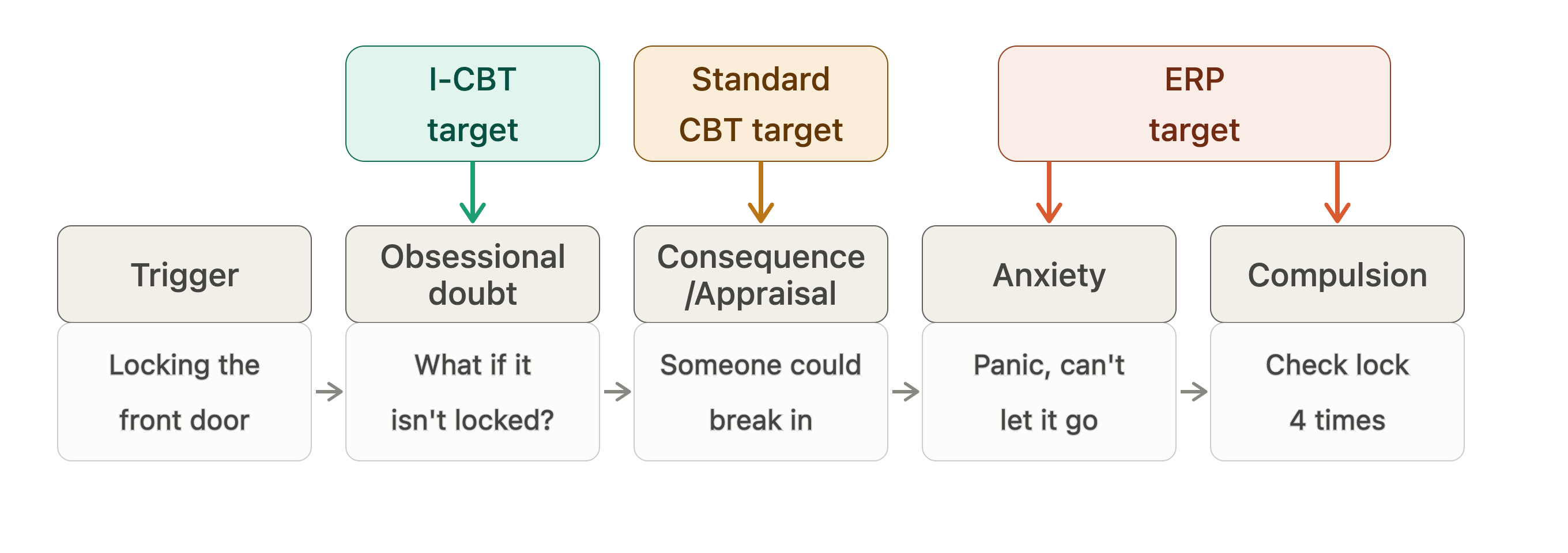
Treatment targets in the obsessional sequence, based on the framework in O’Connor, K., & Aardema, F. (2012). Clinician’s handbook for obsessive compulsive disorder: Inference-based therapy. Wiley-Blackwell.
The above image indicates that I-CBT works on the (obsessional) doubt, or more correctly, in the space between the trigger and the obsessional doubt. It aims to help the person understand how OCD uses logic against them and tricks them into believing it. This represents one of the major tenets of I-CBT: obsessions are not random.
I-CBT is a treatment which builds upon itself session over session. It has many interventions, and among them is the creation of the obsessional story. The client crafts a narrative which undergirds the obsession(s), and then the therapist helps the client identify the “logic” and “tricks” which OCD uses to keep the person inferentially confused.
Inferential confusion is a key term in I-CBT which basically means that a person is doubting something without any direct evidence or trust in their senses. Inferential confusion happens to all of us, and those people with OCD find themselves inferentially confused more often.
Progressing in I-CBT Treatment
As the client progresses in I-CBT, they come to learn how OCD operates and fools them. The client becomes an expert in OCD’s tradecraft and learns to combat it. The client combats OCD by learning how to trust their senses, re-engage with common sense, and untangle themself from the bubble which is OCD.
One of the key principles of I-CBT is that the client learns to slow down the inferential confusion process, to stand at the bridge between reality and the imaginative world of OCD, and to make the choice of whether to give in or proceed. It can be a scary place to stand, but also a very powerful one.
Where Did the Exposures Go?
Interestingly, I-CBT has no exposure work. You may be asking why that is, and the answer is in the obsessional sequence. Go back up to look at the image.
Exposure work is needed when there are compulsions. In I-CBT, the goal is to work on the elimination of the obsessions. If there are no obsessions, then there can be no compulsions.
That said, in my clinical experience, and in the experience of other providers, exposure work can be incorporated into I-CBT, although it is not common. It is up to the clinician and the client to determine how this will be done. Clients who’ve done ERP before will nonetheless be surprised to hear this.
Psychiatric Medication and OCD
First, you should know that I am not a psychiatrist and do not have any authority to prescribe medication for the treatment of mental illness. I will keep this brief and encourage you to meet with a psychiatrist or other prescribing provider to discuss options.
Medication can be very helpful in the treatment of OCD. Selective serotonin reuptake inhibitors (SSRIs) are commonly used to treat OCD. According to Harvard Health, the dosages of these medications tend to be higher than what is used in the treatment of depression and anxiety, and they may even take longer to show effect. The IOCDF explains that common medications for OCD include citalopram, escitalopram, fluoxetine, fluvoxamine, and sertraline.
There is also emerging research which suggests that N‐acetylcysteine (NAC) could be helpful in the treatment of OCD when used in combination with other interventions. This research suggests that NAC modulates glutamate, a chemical messenger in the brain linked to the overactivity that drives compulsive behaviors and repetitive thoughts. It’s therefore not surprising that glutamatergic medications are of interest in OCD treatment; however, more research is needed.
The IOCDF has a wonderful page about medications in the treatment of OCD that is well worth a read.
The takeaway is that medications for OCD can be helpful, and research shows that adding therapy to medication can improve outcomes compared with medication alone. And again, please speak with a psychiatrist or other prescribing provider for more information about possible medication options and your treatment plan.
Bringing It All Together
If you’ve made it through this series, you’ve covered a lot: what OCD actually is, how compulsions differ from everyday habits, what ERP looks like in practice, and now I-CBT and the role of medication. I want to leave you with a few things to carry forward.
OCD can impact anyone. According to Harvard Health, it affects up to 3% of people globally, and a 2025 study of adults in 10 countries found that about 3% had OCD in the past year. It often begins early in life, yet it’s common for people to live with symptoms for years before they receive an accurate diagnosis. The International OCD Foundation reports that it takes more than 7 years, on average. That same 2025 study found that only about 1 in 5 adults with OCD had received any mental health treatment in the past year.
If that sounds like your story, please hear this: the shame, the doubt, and the habit of explaining your behavior away are common experiences with OCD, and they say nothing about your strength or your ability to get better. Treatment is effective, and there is more than one way to approach it. If you’d like to revisit any part of the series, you can find the posts on what OCD actually is, how compulsions differ from everyday habits, and what ERP looks like in practice.
Don’t Go without Support
OCD is not likely to resolve on its own, and treatment will likely be needed. With treatment, OCD symptoms can improve significantly, and you will be better equipped and prepared to resume life.
When should you consider reaching out for help? On some level, we addressed this in the first post. It’s when the symptoms of OCD are running through your life. You’re late to work and missing meetings, spending more time entertaining compulsions than with your own family, or worse yet, you’re on the brink of losing a job or a relationship. You’ve not seen your friends in months because you’re afraid you won’t be able to stop counting at the dinner table. You doubt whether you’re the kind of person who could lead a normal life.
You now have a name for this, and it’s called Obsessive-Compulsive Disorder, or OCD. You’re not just a particular person or someone preoccupied with neatness. OCD is a debilitating mental health condition, and you may have already gone months or years without help. Now is your time to schedule a consultation with us.